
Wholesale Custom Jewelry: Sampling Before You Commit
A physical sample is the last inexpensive decision point in a wholesale program. It arrives after a 48-hour CAD stage and a 25–30 day sampling window, and it is the only moment when metal weight, plating colour, stone security and clasp feel can be judged together before 3–4 weeks of production lock the specification in place. Once bulk starts, changes cost a mould, not a meeting.

Key takeaways
- Budget 25–30 days for a master physical sample, with wax printing, casting, setting, polishing and plating inside that window.
- CAD is returned in under 48 hours, or 2 days, and is the lowest-cost stage at which to change a dimension.
- Approve against a written spec covering metal, karat, layer count, hallmark, clasp and packaging, not against a photograph.
- One revision round adds another 25–30 days, pushing a 48–60 day path to delivery into the 73–90 day range.
From brief to sample: 48 hours, then 25–30 days
The sequence starts with a brief: sketches, reference photographs or a technical pack. Consultation settles feasibility, material and cost structure. Then comes CAD modelling in under 48 hours, delivered with realistic renderings so dimensions and proportions can be signed off before any metal is cut. Only after that sign-off does the master physical sample begin, and it takes 25–30 days because five separate operations sit inside it — 3D wax printing, precision mould casting, stone setting, polishing and custom electroplating.
Read those two numbers together and the shape of the risk becomes clear. The 48-hour stage is 2 days; the sampling stage is 25–30 days, or 3.6–4.3 weeks. Anything decided in CAD is cheap to change. Anything discovered after casting is not, because the mould already exists and the plating batch has already been scheduled.
What to inspect when the parcel arrives
A sample is not a beauty object; it is a specification you can hold. Put it under daylight and under a bench lamp, compare it with the approved render, and work through the physical checks in order. Measure before you admire. A ring that is 0.3 mm off in band width will feel wrong across a whole size run, and a clasp that opens smoothly on the bench may not survive a week of daily use.
Weight deserves its own line in that review. On a silver piece, the tolerance written on the drawing is what the metal cost is built on, so a sample that is 0.4 g heavy is not a rounding error repeated 50 times — it is a permanent change to the unit economics of the design. The same logic applies to plating appearance at the edges, where a thinned layer shows first and where a customer will look after a month of wear. The sterling silver jewelry manufacturer page sets out how the 925 line is built, which helps when reading a silver sample against its spec.
| Check | Pass condition | Why it matters later |
|---|---|---|
| Hallmark | S925, 316L or 18KGP struck where the drawing shows it | Hallmarks cannot be added after plating without marking the finish |
| Plating colour and coverage | Matches the approved render in daylight; no thin edges or bath marks | Colour drift between batches is the most common return reason |
| Stone security | No movement under light finger pressure; settings sit flush | A loose stone in a sample becomes a loose stone in a run |
| Clasp and articulation | Twenty open-close cycles without stiffness or slip | Findings are bought in lots and cannot be upgraded mid-run |
| Dimensions and weight | Within the tolerance written on the CAD drawing | Weight sets the metal cost of every later piece |
| Packaging proof | Backing card, pouch, box and barcode label fit the piece | Packaging is ordered against the same approval date |
Paperwork that should travel with the sample
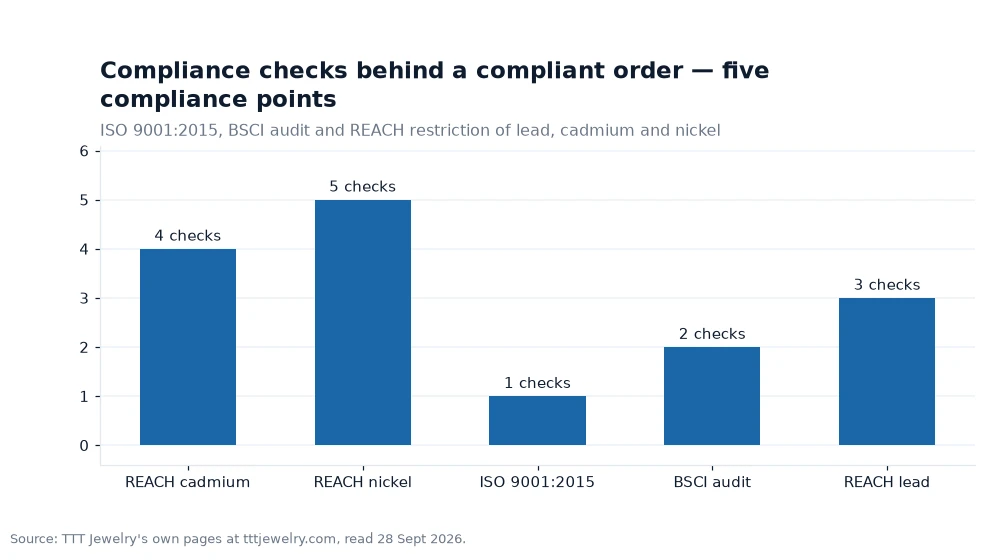
Specification is only half the file. A buyer committing to a run also needs the compliance position in writing: ISO 9001:2015 for quality management across production stages, BSCI for labour and social audit, and REACH compliance confirming the material is free of lead, cadmium and nickel. Plating should carry its own statement of 100% compliance with REACH and CA Prop 65. Those four lines are what a retail buyer or an importer will ask for before the carton leaves the origin port.
Buyers who want the sampling schedule and the compliance statements tied to one written specification should get a quote before the mould is cut, not after. A quote that names the metal, the karat, the layer count and the packaging list is also the document that makes a sample approval meaningful, because both sides are judging the same thing.
Approve, revise, or restart
Three outcomes follow inspection, and each has a different cost. Approval is straightforward: sign, and bulk production begins, typically 3–4 weeks, with 100% inspection before delivery. A revision is a controlled change — a plating tone, a stone size, a clasp swap — and it consumes another sampling cycle of 25–30 days if a new master is needed. A restart means the concept itself was wrong, and the CAD stage begins again from the 48-hour mark.
The practical rule is to separate cosmetic from structural findings. Cosmetic notes that do not touch the mould can often be handled in the plating or polishing stage. Structural notes — band width, setting depth, hinge geometry — belong in a new sample. Sorting the two lists before the review call keeps a two-week conversation from becoming a two-month one.
Sampling several designs at once changes the economics of that decision. Three designs approved in parallel still consume one 25–30 day window, so a revision on one of them delays only that design if the factory schedules the others separately. The same three designs sampled one after another consume three windows, or 75–90 days, before production begins. Parallel sampling is the single scheduling choice that buys the most calendar for the least money.
Worked example
A silver pendant program on a clean path: CAD at 48 hours is 2 days, sampling runs 25–30 days, and production runs 21–28 days. The total is 2 + 25 to 30 + 21 to 28 = 48–60 days, or roughly 7–9 weeks. Now add one revision round at the full 25–30 days, because a new master is needed: 48–60 + 25–30 = 73–90 days, which is 10.4–12.9 weeks. The revision adds 50% to 52% to the original calendar while the piece count and the MOQ stay exactly the same. That is the arithmetic behind approving CAD carefully: two days of drawing review protects against a month of re-sampling.
Frequently asked questions
How long does a physical sample take?
25–30 days for a master physical sample, counted from CAD sign-off. The window covers wax printing, casting, stone setting, polishing and electroplating. CAD itself is returned in under 48 hours, so the two stages together run about four to four and a half weeks.
Can a sample be approved from a 3D render alone?
No. A render confirms geometry, proportion and stone placement, and it is the right tool for catching dimension errors early. It cannot confirm plating colour under daylight, the feel of a clasp, the weight in the hand or how a setting sits against the skin.
What happens to the sample after approval?
It becomes the reference piece for the run. Production is checked against it, and 100% final inspection compares each unit with the approved standard. Keeping the signed sample and its written spec together is what makes that comparison possible months later.
Building the approval file
Approval is a document set, not a signature. The signed sample, the CAD drawing with tolerances, the plating specification, the compliance statements and the packaging proof belong in one folder that travels with the order from sampling through final QC. For a stainless program, the stainless steel jewelry manufacturer page is a useful starting point on the substrate and PVD route. Build that file before production starts and the run has something to be measured against.
Source note: figures come from the manufacturer's own website (tttjewelry.com), read 28 Sept 2026.[1]