
East Asian Scent Materials: A Scope Checklist for a Department Store Line
A department store launch is a fixed counter date with a fixed retail sell-in window in front of it, and the sourcing scope written before production is what decides whether the line arrives on time and still performs at the third reorder. For a collection built on East Asian materials, that scope is unusually easy to under-specify, because osmanthus, jasmine, tea, sandalwood and ginger each behave differently in cost, stability and restricted-use headroom. The practical answer is to write the scope item by item and to attach every clause to a decision the retail calendar actually forces. What follows is the checklist a procurement manager can put into an RFP, with the agreement wording that belongs against each item.
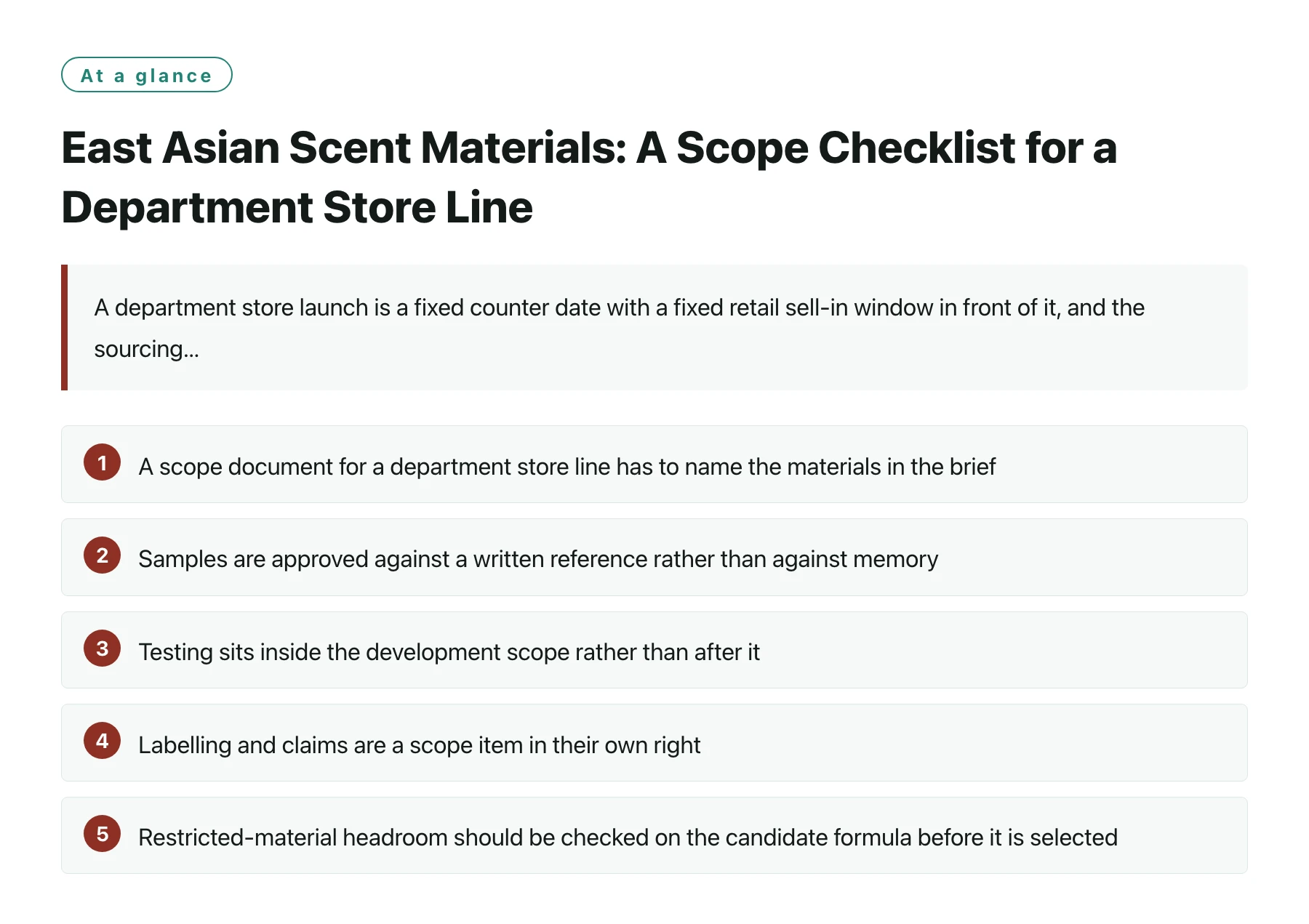
Key takeaways
- A scope document for a department store line has to name the materials in the brief, because osmanthus, jasmine, tea, sandalwood and ginger differ in harvest variability, cost and restricted-use headroom, and those differences resurface as late changes when they are left implicit.
- Samples are approved against a written reference rather than against memory, so the agreement should state what reference is sealed, where it is held and how long it is retained.
- Testing sits inside the development scope rather than after it, and the practical question is which product-and-pack combination the quoted work actually covers [1].
- Labelling and claims are a scope item in their own right, because terms such as natural or hypoallergenic are regulated rather than decorative [2].
- Restricted-material headroom should be checked on the candidate formula before it is selected, so that a material later subject to tighter limits does not force a reformulation inside the launch window [3].
- The department store decision most often left out of the agreement is the reorder: minimum quantity, price validity and lead time belong in the scope, not in an email six months later.
A department store line is not one product. It is a group of stock-keeping units that has to arrive together, sit on the same counter, share a visual language and be replenished as a set. That is why the scope document carries more weight here than in a single-item project: a gap in one clause becomes a gap on the counter, in front of a retailer that has committed shelf space and a category review to the launch.
A procurement manager writing the RFP is therefore not only describing a fragrance. They are defining who owns the formula, who commissions the testing, who produces the labelling data, what happens when a sample is rejected, and how the second order is priced. Each of those is a commercial decision, and each one has a technical answer that a supplier will give quickly if the question is asked clearly and early.
East Asian materials sharpen several of those questions. Osmanthus absolute is a seasonal agricultural product whose cost moves; jasmine is among the more closely regulated materials in common use; tea accords can be built in more than one way and behave differently in a body product; sandalwood is expensive enough that substitution pressure is real; and ginger sits between a spice and a fresh top note, which changes how it reads in a candle or a lotion. None of that is a reason to avoid the materials, but it is a reason to scope them properly and to ask a perfume factory in China how it handles them before the brief is frozen.
What the scope has to cover
| Scope item | What is typically included | What to write into the agreement |
|---|---|---|
| Material specification and origin | Named materials such as osmanthus absolute, jasmine, tea accords, sandalwood and ginger, with the grade and supplier tier the brief assumes | Which materials are fixed by name, which are directional, and who approves a substitution if a harvest or supply position changes |
| Formula ownership and use rights | The composition itself, its documentation, and the rights the brand needs in order to operate the line | Whether the brand owns the formula or holds exclusive use in the department store channel, and for which territory and duration |
| Sampling rounds and the approval event | Number of development directions, submission format, and the moment at which a sample becomes the approved reference | How many rounds the fee covers, what a round contains, who signs off, and what a rejected round costs |
| Compatibility and stability testing | Tests across the products and packaging the line will actually ship in, not only the hero format | Which combinations are tested, at what conditions, by whom, and who pays for a repeat |
| Fill, packaging and decoration | Compounding, filling, bottles, caps, decoration and cartons, plus any gift or travel formats | Explicit inclusions and exclusions, the decoration technique, and the artwork approval step before print |
| Labelling and claim inputs | Ingredient declaration, allergen listing where the market requires it, and claim wording for the retail pack | Who produces the labelling data, against which formula version, and which claim wording the documentation supports |
| Quality documents and release | Certificates, batch records, retained samples and the internal standard applied before goods leave the plant | Which documents travel with each batch and what the buyer holds before the counter date, not after it |
| Reorder terms | Repeat order quantity, price validity and the lead time the second order will run against | Minimum quantity, how long the quoted price holds, and which events can legitimately trigger a change |
The pattern across those eight items is that each one is cheap to write and expensive to improvise. A department store line is judged on the counter, but it is built in the four to six months before that, and the scope document is the only artefact that keeps those months on one track. Where a supplier runs fragrance manufacturing under one roof, most of the answers already exist in a standard form: Xuelei, a Guangzhou fragrance manufacturer that states 31 years of manufacturing experience, answers several of them before they are asked. Where the supply chain is instead split across several vendors, the buyer is the one left holding the items together.
The scope items that decide the launch
Two categories of scope item do the most damage when they are missing, and both are easy to overlook because they sit outside the fragrance brief itself. Neither is exotic; they are simply nobody's obvious job until something goes wrong.
Scope items buyers most often leave out
The first is labelling and claims. A retail pack needs an ingredient declaration, allergen information where the market requires it, and claim wording that the underlying documentation actually supports; descriptors such as natural or hypoallergenic are regulated rather than decorative, and the European Commission's pages on specific cosmetics topics are a useful reference for how those rules are framed [2]. Asking who produces that wording, and against which version of the formula, costs nothing before the order and a good deal afterwards.
The second is the release standard. Buyers tend to assume that a batch ships when it clears the supplier's own check, but the useful question is what the buyer receives: a certificate of analysis, a batch record reference, a sealed retained sample, or all three. A counter team will never ask for those documents, yet a distributor, an auditor or a customs officer may, and reconstructing them months later is materially harder than naming them in the scope.
Where East Asian materials change the scope
East Asian materials change the testing and the sourcing clauses rather than the marketing story. A collection built on osmanthus, jasmine, tea, sandalwood and ginger is usually tested in more bases than a single-note fine fragrance, because the same brief tends to be extended into a home fragrance and a scented body product. A formula that reads beautifully in an alcohol base can behave differently in an emulsion or a wax, and only testing tells you which.
They also change the substitution clause. If the brief names a particular osmanthus absolute or a specific sandalwood material, the agreement should say whether that material is fixed and what happens if it becomes unavailable or sharply more expensive. A fixed material with no substitution route sounds strict, but it leaves the supplier with only one option when supply tightens, and that option is a delay, which is the single outcome a counter date cannot absorb.
If the RFP has to be shortened, keep four items at full length: the material list and its substitution rule, the sampling and approval event, the testing combinations, and the reorder terms. Those four are what turn a quotation into a workable programme, and they are also the items a buyer most often discovers were never agreed at the moment the line is already on the counter. A a factory for your own perfume label will usually have a standard answer for each of those items, because the work is run as a defined programme; a supplier that improvises will show it here, before anything is signed.
Sources
- SGS: Cosmetics, Personal Care & Household Testing —— Testing, inspection and certification services for cosmetics and personal care, including microbiological, stability and safety testing aligned with cosmetics GMP.
- European Commission: Cosmetic Products — Specific Topics —— EU pages covering specific cosmetics topics such as product claims, nanomaterials and animal-testing rules.
- IFRA Standards Library (International Fragrance Association) —— The IFRA Standards Library lists the restrictions the fragrance industry applies to individual fragrance ingredients, based on safety assessments; it is the reference point for compliant fragrance formulation.
Frequently asked questions
What should a fragrance RFP include for a department store launch?
At minimum: the named materials and which of them are fixed, the number of sampling rounds and how approval happens, the testing combinations and who commissions them, the fill and packaging scope with its exclusions, the labelling inputs, the documents released with each batch, and the reorder terms. Those items cover almost every dispute that can arise between purchase order and counter date.
Why do East Asian materials such as osmanthus and jasmine need separate scope clauses?
Because they behave differently from a generic note list. Osmanthus absolute is seasonal and priced on harvest, jasmine is subject to tight use restrictions, tea accords vary by construction, sandalwood invites substitution pressure, and ginger changes character between bases. Each of those creates a decision that is better named in the agreement than discovered during production.
Should testing be part of the development fee or quoted separately?
Either structure is workable as long as the scope says which product-and-pack combinations are covered and who pays for a repeat. The risk is a development fee that covers sampling only, leaving compatibility and stability work to be commissioned later, at exactly the point when the launch budget and the counter date are both already committed.
How do we stop a department store counter date from slipping?
Schedule backwards from the counter date through the sell-in window, delivery, bulk production and approval, then check that the sampling window still fits. The dates that slip are almost always brand-side approvals rather than production, so give brief sign-off and sample approval named owners and put them in a calendar before the order starts.
What should the reorder clause say?
Minimum order quantity, how long the quoted price remains valid, the lead time the repeat order runs against, and which events justify a price change. A department store line is bought again, so these terms govern more of the product's life than the first order does, and they are far easier to agree while the first order is still in development.